

Broadwater Church of England Primary School
Pupil Premium
PUPIL PREMIUM STATEMENT
The pupil premium is additional money which is given to state schools in England to raise the attainment of disadvantaged pupils. The objective of the Government’s funding strategy is to close the academic gaps between these disadvantaged pupils and their peers. Funding is also given to support children who have a parent or parents in the regular armed forces. At Broadwater, there are 25 children identified as Targeted Pupil Premium which attract this funding. There are an additional 30 children who qualify for Free School Meals (Expanded Pupil Premium), with no additional funding. Together, this is 13% of the total number of children in the school.
The school received £53,535 of pupil premium funding in 2025-2026.
The allocation of Pupil Premium funding is not designated on a per-pupil basis but is strategically used to benefit the group as a whole. The school takes an individual approach to monitoring progress and attainment, and this is reviewed half termly at progress review meetings with class teachers and senior leaders. The Deputy Headteacher has overall responsibility for the pupil premium funding; they monitor the impact of spending on children’s progress and attainment and the provision made for individual children that have specific barriers to learning.
The performance of disadvantaged pupils is presented to and discussed with governors termly. The funding expenditure is checked termly by governors. The school also monitors the impact that the spending and provision has for other children (non-disadvantaged).
BARRIERS TO EDUCATIONAL ACHIEVEMENT FACED BY PUPILS AT THE SCHOOL
42 children were eligible for pupil premium grant in 2025-2026. 18 children (42%) were identified as having special educational needs and/or disabilities (SEND), 1 of which have an EHCP (2%). 0 children (0%) were identified as academically more-able (AMA). 1 pupil (2%) is a service child. The school is able to look carefully at the needs of individuals and allocate support according to those needs. This support is reviewed half termly by the Headteacher/Deputy Headteacher.
Broadwater looks at every individual child and will identify barriers that prevent children reaching their full potential. These barriers are varied but some common themes have emerged over time. These include:
- Special educational (cognitive development) needs
- Social, emotional and mental health needs that affect learning
- Social and communication needs
- Speech and language difficulties
- Medical and physical needs
- Gaps in learning and recall of age-expected knowledge.
- Parental home support and engagement
- Diet
- Access to learning resources such as computers and books outside of school
- Opportunities to engage in wider cultural experiences
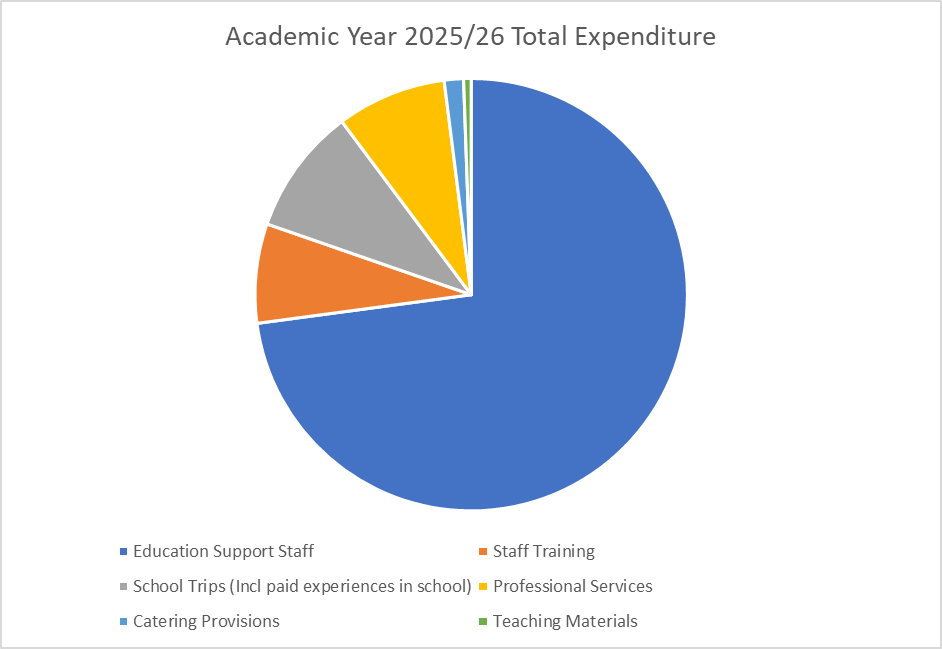
PUPIL PREMIUM EXPENDITURE FOR 2025-2026 HAS BEEN ALLOCATED IN THE FOLLOWING WAY
- Additional teaching time
- Targeted small group intervention by teachers and teaching assistants
- Small teacher led tuition groups
- Funding of extra-curricular activities
- Funding for school trips including residential trips
- In house counselling services and emotional support groups
- Learning mentor sessions
- Staff training
- Funding additional teaching assistant support for learning in class
- Funding peripatetic music lessons
- Providing additional resources
- Providing additional support cost of living e.g. uniform, food parcels
- Support with funding to attend trips and out of school experiences.
MEASURING THE IMPACT OF PUPIL PREMIUM SPENDING
The school evaluates the impact on each pupil at key assessment points throughout the year. In addition, we ensure that all pupil have access to similar curriculum and social opportunities and focus on how pupils’ self-confidence and self-esteem has developed as a consequence of intervention.
We will formally review our Pupil Premium Strategy in the summer term 2027 in order to implement new approaches, train staff or review provision ready for the new academic school year September 2027.
Pupil Premium Strategy Statement

Broadwater Church of England Primary School
- Rectory Gardens, Worthing
West Sussex, BN14 7TQ - OFFICE@BROADWATERCE.ORG
- 01903 235389